
Just before the turn of the millennium John Paul Flintoff published an excellent book on his time at Holland Park Comprehensive School in the early to mid 1980s called ‘Comp – A Survivor’s Tale’. As the title suggests the account was not entirely complimentary although some reviewers have suggested many of the accounts he includes are exaggerated.
In the broader picture though Holland Park is quite an outlier in the scheme of things. Opened in 1958 it was billed as a flagship for comprehensive education, while earning the nickname ‘the socialist Eton’. Notable former pupils include Hilary Benn and Polly Toynbee. A scan of the internet produces a plethora of intriguing stories that have happened there through the years. So, what was the reality of life like at a more middle of the road comprehensive back then?
My time at comprehensive school was just before Flintoff’s, being from 1979 to 1983. How you actually ended up as a pupil at a particular comprehensive school back then was far different to today. School league tables didn’t start being published until 1992. There were of course catchment areas which when applied left you with six or seven options.
In the absence of such information and in an age where car ownership by parents was much lower than it is today, most people opted for the school that was closest to them. However, in what would be viewed as the more prosperous areas, there was an informal grapevine that could result in a different outcome. Some parents had elder children at a school that had disappointed them, others were friends with teachers who had tales to tell of their experiences. In these cases the further distances to travel were deemed worthwhile, having said that it was a small minority.
From a social history perspective this is where matters got interesting. A DES (Department of Education and Science) circular from 1965 had stated the aims of comprehensive schools as ‘to provide a broad education for all pupils within a given area, regardless of their academic ability or social background, eliminating the selective system of grammar schools’.
Over the years I have begun to question if I had imagined our last year middle school group being asked to sit what appeared to be a MENSA style intelligence exam in the dining hall. It was all very understated, not mentioned beforehand and billed by the teachers as ‘just a little test’. Was this our version of the 11 plus I wonder?
Ultimately if the test existed or not became irrelevant on our first day. By whatever means we had indeed been split into form groups dependent on academic ability. Perhaps predictably these classes bore more than a passing resemblance to the housing values of where the pupil resided and occupations of the parents.
The year before our arrival the Waddell Report had made a recommendation that the current examination system of ‘O’ levels and CSE’s should be replaced by a single exam. It noted that the former were intended for the top twenty per cent of academic ability, with CSE’s broadly the next forty per cent. Crucially that was how we were going to be taught as well. The top two classes academically being the only ones with a realistic chance of ultimately sitting ‘O’ levels. This meant that the selective element the comprehensive ideal had been aiming to eliminate had been replaced by another route.
The school in question was George Eliot in Nuneaton. Named proudly after its most famous daughter it was the one closest to my home. Since league tables have been published it seems it probably was a poor choice and the extra travel elsewhere would have been worth the effort, but of course at the time I had no idea of that. The school catered for roughy eight hundred pupils split into four year groups. Resulting in around seven classes of thirty for each year group.
Here’s a thing though. When you are younger and have never been in a workplace environment, you assume that your teachers are both all knowing and of equal value. A working life later you realise they are largely reflective of all workplaces being a mixture of good, bad and indifferent. At this point the expectation might be that I would suggest the teachers at George Eliot back then were largely in the bad category.
In reality from my perspective that wasn’t the case. Probably the majority were good, with a detailed knowledge of their subject and seemingly a genuine interest in teaching it. A few were happy to do the bare minimum, maybe a quick explanation followed by setting a question to work on, then disappearing out of the classroom. Then there were a minority who had embarked on the wrong profession completely. Unable to control a class or somehow managing to lose a whole forms exercise books that they had kept the lesson before for marking for example.
Additionally there were occasional whispers that the most academically able classes had been given the best teachers. I don’t know if that was true or how objectively, certainly back then, it could be proved either way. An absolute fact though is that only the ‘top’ two classes were let near subjects such as French, German or English Literature.
In fairness while this meant a grammar school education was still going on almost by default for a few (albeit not to the standard of an actual one), it was a time in history where it was difficult for the education system to gauge exactly what eventual leavers it should be producing.
Nuneaton was still very much a place where people were involved in making things. For example, many people travelled to Coventry each day to work in what was becoming an increasingly struggling motor industry, the Sterling Metals factory (producing castings in iron and other alloys) sat just across the road from the school and even coal mining was still an option. In contrast probably around fifteen per cent of the population went to university and the vast majority of those hadn’t arrived there via a comprehensive education.
Given the above the obvious conclusion was the value of subjects such as English Literature and languages out in the working world was going to be extremely negligible for most. That being the case it was still compulsory when we chose our exam options in the Spring of 1981 for the boys to do at least one practical subject such as technical drawing, metalwork or woodwork and for the girls home economics, needlework or childcare.
Massive social change was afoot though. During that summer ‘Ghost Town’ by the Specials spent three weeks at number one in the charts. ‘No jobs to be found in this country’ being one line in the haunting lyrics. There were also large scale riots in major towns such as Birmingham, Leeds, Liverpool and London as unemployment reached two and a half million people. Back at school a single computer had appeared for the first time, to be used in conjunction with a subject called Computer Studies (referencing it as Computer Science was still far into the future).
Away from academia the support available to pupils was patchy at best, made worse of course by the early teenage years being famously tumultuous. Again much of this problem could be a reflection of society at the time rather than a fault of the comprehensive system. For example, any concept of mental health was non existent. Sex education consisted of a rudimentary demonstration of how contraception worked, with certainly no thought as to how relationships before or after that point would function.
Nutrition was another neglected area. The two local fish and chips did good business and this was often followed by a large bag of broken biscuits or chocolate from the on-site tuck shop. In many ways with the arrival of so many other fast food options since the 1980s it could be said that the present situation is worst still; but at least much more information is provided for informed decision making
One area where the comprehensive ethos did seem to work though was with sport. In an age before everyone had a phone with a camera very little photographic evidence remains of course. Here is some though. The under fifteen George Eliot football team after winning the North Warwickshire school’s cup. I am second from left on the back row. A successful team that was a genuine mix of all academic abilities from every different estate in the catchment area.
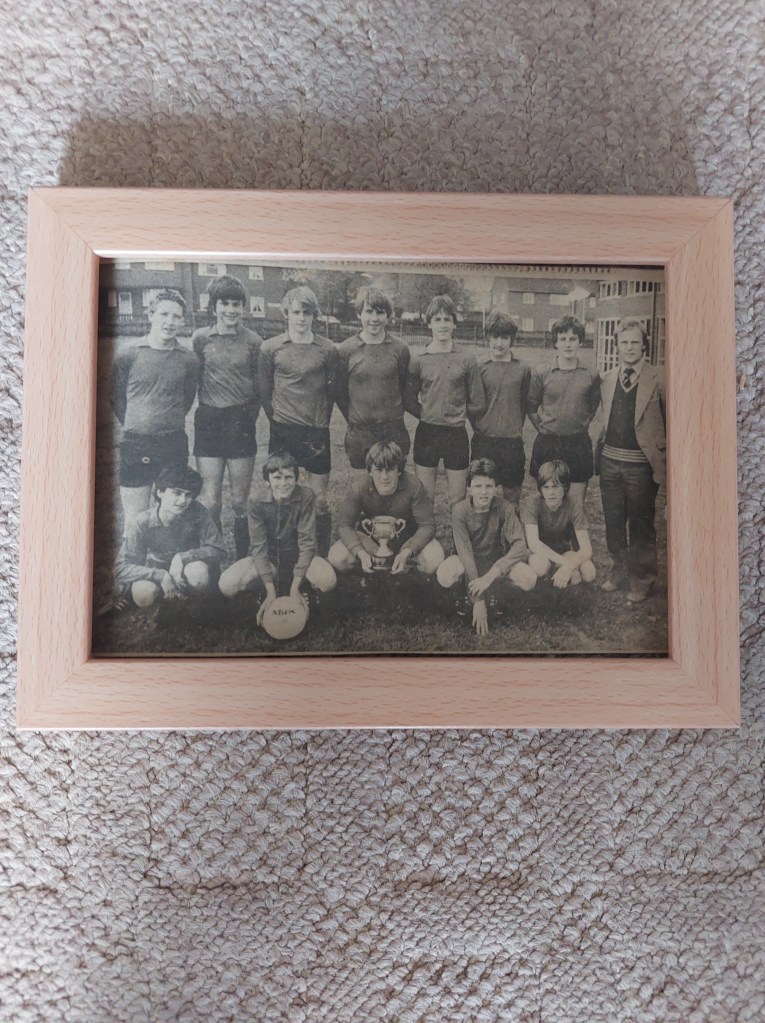
There were some strange elements to sports lessons though. You had to do it without any underwear on for a start, with showers (usually freezing cold) compulsory afterwards. Meanwhile a training session for the cross country team involved running down a long lane with no street lights in the depths of winter, clearly health and safety wasn’t a consideration then. The demarcation lines between what were seen as traditional gender sports were also strong. Football and rugby for the boys, netball and hockey for the girls.
When the time to leave school was approaching there didn’t seem a great deal of advice available career or futures wise. A brief chat and direction towards some literature being par for the course. A couple of people had secured positions or college places that were dependent on getting at least a Grade ‘C’ at ‘O’ level in particular subjects. This resulted in some intensive one to one sessions, with languages and science seeming to present major problems. These are regarded as harder subjects and it’s impressive that teachers were prepared to help in that way but it does suggest that overall academic standards should have been higher in these areas at least.
Ultimately perhaps only ten per cent or so departed to take on further academic study. Apprenticeships or the working world (if employment could be found), still being the most likely scenario for comprehensive pupils then. On reflection though it doesn’t feel as if Flintoff’s assertion that comprehensive school were something to be ‘survived’ feels necessarily true.
Sports at George Eliot showed that a diverse mix of social backgrounds and academic abilities could be fused into a successful unit. Additionally given the massive social change taking place at the time it was impressive that forward thinking (back then) subjects such as German and Computer Studies could be taken, while there was still insistence that everyone also had some practical skills to take away with them as part of the exam options.
However there is no doubt that academically the dye was cast before arrival at comprehensive school. With classes immediately set on academic ability the importance of parental occupations and home backgrounds were obvious. These initial categories were almost impossible to break free from and that meant what you were allowed to study and who you were spending most of your time with was a given from the first day. Interestingly over forty years later this is a problem that continues to be grappled with as various articles appear each results day on the need to improve outcomes for working class children.


 Big Dave
Leave a comment