
‘This place (Town)
Is coming like a ghost town
No job to be found in this country’
Back in 1977 aged ten I used to look forward to Wednesday afternoons after school with great excitement. My mum would have been out shopping in town resulting in two of my favourite things in the whole world combining. Firstly, sausage sandwiches with brown sauce for tea (regrettably not so much consideration given to healthy eating back then). Secondly, a packet of Panini SuperAuto car stickers to open. On reflection it seems each packet only contained five stickers and with the album numbering 200 stickers in total, completion was going to take quite some time.
Finishing wasn’t a massive priority back then though. The anticipation opening each packet was immense and more than enough. A sticker that had a badge or car representing marquee brands such as Ferrari, Rolls Royce or Lamborghini was most desired. However, not far behind from my perspective was any sticker associated with British Leyland. At that point my dad had worked for them (in their various guises) for a quarter of a century. We were also the proud owners of an Austin Morris 1100 (FOB 561 D) which my dad had got brand new in 1967 from them with an employee discount included.
Looking back closer inspection of most of the British Leyland stickers and/or the car on the drive should have told me trouble was ahead. In fact in my ten year old naivety I had failed to realise trouble was already here. British Leyland was a byword for industrial disaster. Bailed out by the government in 1975, numerous strikes and poor products (the Mini, Jaguar XJS and Land Rover being honourable expectations) meant its reputation was in tatters. Consumers flocked to what were seen as better and more reliable products from the likes of Ford and Vauxhall.
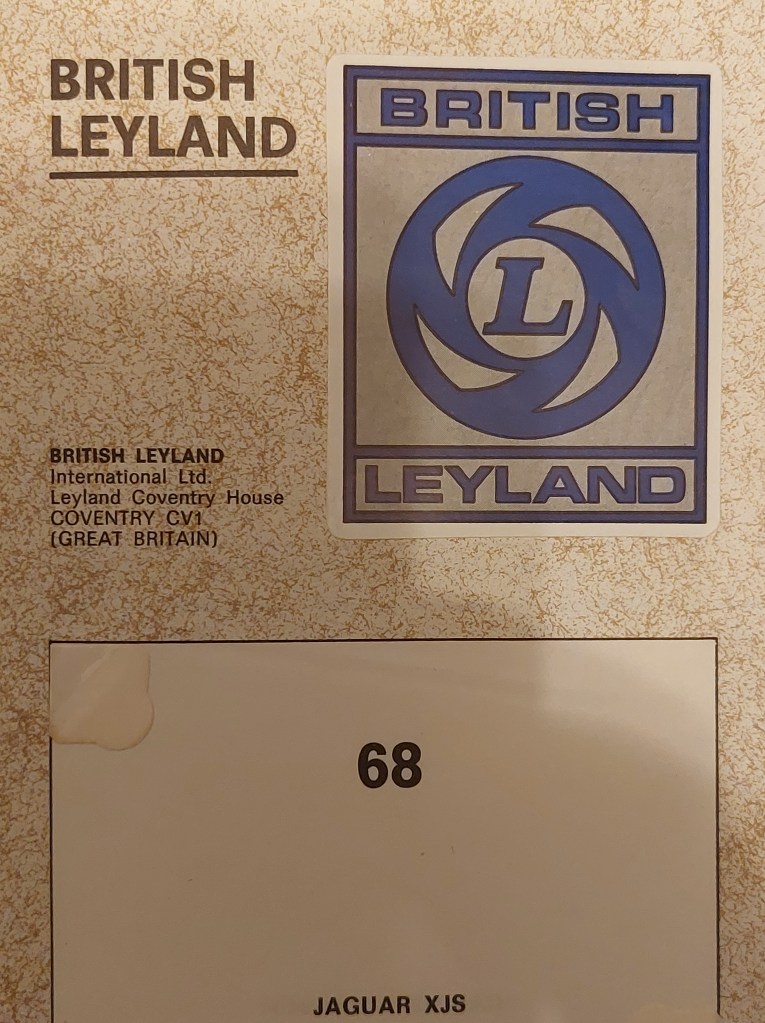
Below is a picture from the album itself. The British Leyland badge proudly in position but unfortunately no sign of what would surely have been an impressive Jaguar XJS sticker. Sadly the other British Leyland stickers that were potentially available were for the Princess, Rover 3500, Allegro and Triumph TR7. Each with their own long list of ownership issues which had contributed massively to the current situation.
The so called ‘Winter of Discontent’ in 1978/79 was probably the final straw. Damaging the Labour government, discrediting the unions and plunging British Leyland into further crisis. Towards Christmas of 1981 my dad received a terse letter from the company. It informed him that he was being made redundant at the end of that year.
During the previous summer ‘Ghost Town’ by ‘The Specials’ had been number one in the singles chart for three weeks. These kind of letters were arriving at addresses across the area on an increasingly regular basis and were tangible evidence of the songs lyrics. Simultaneously close relatives were made redundant from Massey Ferguson and Chrysler. Coventry ceased to be known as ‘Motor City’ or ‘Britain’s Detroit’.
Consequently New Years Day 1982 saw my dad at the age of forty five unemployed for the first time in his life, from the only job he had ever had. Perhaps predictably in hindsight it didn’t go well for him from this point, although it isn’t possible to totally disentangle cause and effect in what transpired. Additionally at this distance of so many years it is difficult to properly remember how much less the world was ‘joined up’ back then and that is undoubtedly an important factor. For example, applying for a job meant either a trip to the job centre or trawling through advertisements in the newspaper rather than the internet.
It would be six years before he was officially employed again. This was in a minor clerical capacity with the Civil Service, part of the role being to greet visitors to the office and guide them in the appropriate direction. He stayed in this role until retirement.
In the intervening years before the Civil Service role there had been some casual helping of my uncle with his painting and decorating business and lots of gardening at my parents and grandparents house but silently in the background many of the effects of long term employment were taking their toll.
Long term unemployment is most usually defined as any period of unemployment that lasts beyond twelve months. Its impacts are often grouped into three main areas. Firstly reduced employability and future prospects, secondly financial hardship and poverty and finally physical and mental health decline.
In terms of reduced employability and future prospects it was clearly going to be difficult for my dad to find the same position he had previously held (toolmaker) when so many people across the city with the same skills were also being made redundant. The problem was exacerbated of course by the fact that was the only work he had ever done.
Perhaps sensing these difficulties he had taken and passed a number of ‘O’ levels at night school in the years before redundancy. Ultimately lack of previous experience in the working world away from British Leyland and being introverted by nature meant these weren’t enough to secure employment. Simultaneously the world was evolving faster than ever before with new skills required to navigate it. Meanwhile the decimation of the mining industry added still more people to the unemployment figures in the region.
Strange as it seems the financial hardship and poverty aspect of the three factors was the least felt. Which isn’t to say it had no effect or in any way to down play it. My dad had been paying the mortgage on the house for a long time and the redundancy payment he received was enough to then clear that debt completely. The aforementioned Austin 1100 was long gone though, so it was either walking, cycling or public transport going forward. Luxuries such as holidays or dining out were a definite no, though this didn’t feel so bad as many people were in the same position and it was a time before these were common place anyway.
At this point you may be wondering where my mum was in all of this. Unsurprisingly her part in the tale is again a reflection of the way the world was back then and what a massive amount of change it has seen since. Before marrying my dad and my appearance in the world she had worked as a machinist in several Coventry factories. Once I arrived the thinking back then was largely that women stopped at home to look after children while the man was the ‘breadwinner’. Interestingly it wasn’t till my dad got much older that my mum’s name even appeared in the deeds for the house. So, in terms of her being able to now go out and get paid work, skills and experience wise she was in a worse position than my dad.
Ultimately the biggest problems were caused by mental health difficulties. As I mentioned earlier my dad was something of an introvert even when he was working at British Leyland. In the 1970s there were a couple of people he saw for a weekly Sunday drink in the pub (one of whom died relatively young) but this habit came to an end when the long standing landlord left. Other than that his social interactions were always all family related or through his work colleagues. After redundancy this was obviously pared down to just family.
This social isolation was coupled with feelings of low self esteem. His generation of course would never admit openly to that or more likely be unaware of what it even was. On mature adult reflection with this distance in time I recall it was just the odd self depreciating comment. Trying to keep busy with home maintenance type tasks for that length of time with no social connections beyond family must have been demoralising though.
My dad died at the relatively early age of seventy from prostate cancer. It went undiagnosed for a long time. Partly because of my dad’s reticence to go to the doctors and partly because the brilliant awareness campaigns of today didn’t exist. I often wonder though how much those years of unemployment fed into the problem. The stress it invoked perhaps causing hormonal changes, impacting the immune system or biological pathways that can lead to prostate cancer.
‘Can’t get on no more
The people getting angry’
The Specials – June 1981


 Big Dave
Leave a comment